
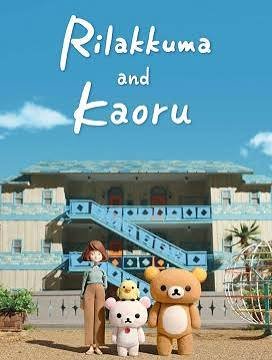
Rilakkuma and Kaoru Review: Kaoru is a single office worker in Tokyo. Nothing about her life is dramatic. She commutes, she puts up with a landlord who’s a bit too invested in her business, she deals with the small daily indignities of being an adult: rent, office gossip, a friend who cancels hanami plans because work ate her calendar. And she lives with three toys who talk. Rilakkuma is a huge, permanently sleepy bear whose main hobbies are eating and not moving. Korilakkuma is his smaller, more annoying sidekick. Kiiroitori is a little yellow bird who is, without question, the only adult in the house.
That’s the whole show. No hidden magic system, no season-long mystery, nobody turns out to be a villain. Thirteen episodes, each its own tiny story, drifting from spring through winter and back.
Since there’s no big plot to walk you through, it’s more useful to just describe an episode or two. In one, Kaoru realizes she’s spending too much money, so the three roommates decide to get part-time jobs, which goes about as well as you’d expect when one of your employees considers “finding a new napping spot” a full day’s work. In another, a rainstorm causes mushrooms to sprout inside the apartment right when Kaoru is dealing with being talked about at the office, and the show just lets those two things sit next to each other without connecting the dots for you. There’s a summer festival episode where Rilakkuma eats his way through every stall without a second thought while Kaoru stands there paralyzed, unable to decide what to try first, which is a genuinely funny little joke about the gap between his brain and hers. There’s even a ghost episode, a blackout brings a spirit into the apartment, played more cozy than scary.
The one people bring up most is the snowman episode. Rilakkuma builds a snowman, dances with it, and then falls apart a little when he realizes it’s going to melt once the weather turns. It’s maybe a minute and a half of actual plot. But that’s the whole show’s philosophy in miniature: use a not-very-bright bear to say something true about things ending, and let it land on a five-year-old and a thirty-five-year-old in totally different ways.
| Detail | Info |
|---|---|
| Title | Rilakkuma and Kaoru (リラックマとカオルさん) |
| Format | Stop-motion animation, 13 episodes, ~12 minutes each |
| Platform | Netflix |
| Premiere date | April 19, 2019 |
| Rating | TV-PG |
| Studio | dwarf studios, produced with San-X |
| Voice cast (JP) | Mikako Tabe (Kaoru), Michihiko Hagi (Rilakkuma) |
| Voice cast (EN dub) | Lana Condor (Kaoru), Cam Clarke (Rilakkuma) |
| Sequel | Rilakkuma’s Theme Park Adventure (2022) |
| IMDb rating | 8.2/10 |
Why it looks so good
Netflix’s other big animation swing with this same corporate lineage is Aggretsuko, the one about the red panda who screams death metal to cope with office life. Both shows trace back to San-X, the stationery company behind most of Japan’s cute-character economy. But where Aggretsuko is loud, this is the opposite of loud. It’s not trying to release anything. It’s just piling up small, warm moments and trusting that’s enough.
The stop-motion is doing a lot of the work here, honestly. Watch the mushroom episode again and notice that the real pleasure isn’t the plot, it’s the light coming through the window, or the way the felt looks slightly damp. Somebody spent a long time getting that right. This was Netflix’s first stop-motion series, and it plays like the studio wanted to prove the format could still be this patient and tactile, not just efficient.
The bear carries less than the bird does
Rilakkuma is basically a joke about doing nothing, stretched across thirteen episodes, and he’d get old fast without good scene partners. Luckily he has them. Korilakkuma brings the chaos, Kiiroitori brings the exhaustion of being the only responsible one in a house of two bears and a human who’s also kind of a mess. Together they read less like pets and more like the roommates everyone wishes they had, the kind who ask nothing of you except that you come home at the end of the day.
Kaoru gets more depth than a show like this usually bothers with. She’s not just a stand-in for the cute stuff to happen to. She’s specifically a woman in her early thirties, dealing with the particular flavor of loneliness that shows up once your friends get busier, your job stalls, and coming home to a quiet apartment starts to feel different than it used to. The show never says any of this outright. It just lets you notice it.
Who this isn’t for
If you need things to happen, you’ll be bored. There’s no tension anywhere, unless you count Rilakkuma burning a batch of pancakes as high stakes. Marathon a bunch of episodes in a row and they start to blend together into one long, pleasant hum rather than thirteen distinct stories. Anyone hoping for the kind of formal ambition Netflix’s animation slate sometimes reaches for elsewhere will find this stubbornly small in scope, on purpose.
It also wants a specific mood from you. This is not a show for when you want to be entertained. It’s a show for when you want to feel okay for twelve minutes. If you came in expecting something with Aggretsuko’s edge, the gentleness might throw you off.
Bottom line
This show isn’t good by the metrics that usually matter: no twists, no stakes, nothing pulling you forward. What it’s actually good at is being a genuinely calming, carefully made hour and a half, cut into thirteen pieces, and it does that about as well as you could ask. It’s rare to find something aimed at kids that also has something real to say to the adults watching alongside them, and most of what it says comes down to: show up, eat something warm, and let the people around you (bears included) be as tired and imperfect as you are.
It did well enough to get a follow-up season, Rilakkuma’s Theme Park Adventure, in 2022, which is a reasonable next stop once you’ve finished this one.
Best for: a slow evening, anyone who liked the low-key sadness under Aggretsuko without wanting the screaming, and anyone who wants a reminder that stop-motion can still be this unhurried.
Skip if: you need plot, stakes, or a reason to keep watching beyond it being nice.







Add comment